













Let’s Connect & Accelerate Your Organic Growth
- Your data is properly secured encrypted by SSL
Summarize this blog with :
SEO for financial services is a high-stakes initiative, considering how buyer scepticism is among the highest across categories. It comes from a need to build trust, and, of course, the stringent regulations in the sector. SEO Services for the financial sector are unique, since they operate in the realm of Google’s YMYL (Your Money or Your Life) tier, needing strict regulatory compliance and meticulous trust-building.
It is for banks, insurers, fintechs, wealth managers, financial advisors, and other industry stakeholders.
What You’ll Learn:
|
What is Financial Services SEO?
SEO for financial services is a strategy to ensure higher organic visibility that is tailored to banks, wealth managers, insurers and fintechs. This blueprint is built around compliance, trust and high-intent searches. What you should know is that it’s different from generic SEO, since there’s higher YMYL scrutiny and regulatory constraints, along with longer buyer consideration cycles.
Strategic E-E-A-T optimisation is the cornerstone of this strategy, along with compliance-first content, high-intent keyword mapping (that targets particular and transactional search terms) and AI and voice search optimisation. The core goal is organic visibility through higher search rankings, credibility, trust and authority building, and more citations by emerging AI platforms or engines.
Why Financial Services SEO Matters More Than Ever
SEO services for the financial sector matter more than ever today, as you will ultimately realise. The contemporary financial consumer is at the heart of this transformation, demanding authoritative and immediate clarity and answers, thereby shifting the competitive arena for banking, fintech and wealth services completely to search engines. With internet penetration crossing a whopping 880 million users in India, a huge majority of financial research and discovery now starts online. Hence, not being visible in organic search results will lead to lost market share above all else.
What you should also realise is that financial topics affect the lives of users more directly and acutely. Hence, Google classifies them as YMYL (Your Money or Your Life). Search algorithms also enforce stringent E-E-A-T (experience, expertise, authoritativeness and trustworthiness) standards in this sector. If you’re utilising SEO-optimised and strategic content, then you can capture highly qualified leads, while outstripping your rivals and building the vital consumer trust that is required in today’s digital-first market.
Increased Organic Traffic and Lower Cost of Acquisition vs. Paid
SEO for financial services will also help you drive lower costs of acquisition (CAC) by avoiding highly volatile and expensive CPC (cost per click) trends. Where paid Google Ads in insurance and finance may come with sky-high CPCs, focusing on organic search will get you zero ongoing pay-per-click fees, thereby bringing down your overall acquisition costs significantly.
You shouldn’t just aim for more traffic; you should look at higher conversions, qualified leads, and better CRO (Conversion Rate Optimisation). Unlike paid campaigns that stop immediately when you stop paying, optimised SEO strategies and financial content will be compounding digital assets that help you keep capturing users with high buying intent and lowering your dependence on costly sponsored listings. A robust SEO service will help you build the long-term credibility you need, while getting you more visibility, lowering your lead costs, and ensuring better ROI (return on investment).
Higher-Quality, Higher-Intent Leads
One of the benefits you can expect when you opt for SEO for financial services is higher-quality and high-intent leads. Organic search leads in the financial services industry usually convert at considerably higher rates than regular display or social ads. This is because they are mostly generated by active pull marketing instead of interruptions. These are people who are actively doing their homework on decisions like investments, loans, insurance, etc.
While social media and ads usually interrupt people with generic pitches, organic search captures those who are already inclined towards financial decisions. Remember that your target audiences are in the informational intent or research phase. They will want to build foundational trust in your entity and seek more knowledge. There is then transactional intent, i.e., when users are ready to take action. Reaching at the right moment will generate highly qualified leads that are more likely to convert as well.
Long-Term Brand Trust and Authority
Consistent search visibility with SEO for financial services is the ultimate sign of the credibility of your brand. So, instead of depending on just one campaign, ranking for a wide range of relevant queries will signal better topical authority and long-term market leadership. The aim will be linking your search visibility to brand credibility, and that is possible with topical coverage and broad financial themes that establish you as an industry authority. Regulatory and verifiable E-E-A-T expertise with author credentials, leadership bios, and regulatory disclaimers are also essential.
Another aspect here is user intent targeting with specific long-tail keywords and queries. You have to answer particular questions directly to build more confidence prior to engagement. You also have to deploy local SEO to be more visible throughout regional searches, while optimising your Google Business Profile (GBP) as well.
The Unique SEO Challenges in Financial Services
There are several challenges inherent in SEO for financial services as well. Some of them include:
- Higher competition: The challenge lies in high-volume keywords, i.e., personal loan, being usually dominated by bigger national players and aggregators. It’s hard to rank for broader terms as a result.
- Lead-gen focus: Financial SEO is not just about vanity metrics; it will need a direct pathway to the sales pipeline. The challenge lies in financial products often having longer and research-intensive buying journeys, where generic traffic does not convert without proper trust signals.
- Complexity of topics and regulatory aspects: Financial products are subject to stringent regulatory guidelines, tax codes, and other topical complexities. The challenge is content that’s not aligned with regulatory aspects or excessively generic, leading to higher bounce rates.
- YMYL standards: Search engines classify financial content in the YMYL category, while also penalising sites lacking the right E-E-A-T.
YMYL Content and Google’s Quality Bar
In the context of SEO for financial services, it’s time to closely look at YMYL content creation and the quality barriers imposed by Google. You will require the right Content Writing Services to create the right content that fits into the E-E-A-T (experience, expertise, authoritativeness, and trustworthiness) framework. Now, Google applies stringent quality signals to YMYL (Your Money or Your Life) content. Let’s take an example- suppose there are two articles targeting the same search query: How to maximise your pension fund before retiring.
The article that’s poorly sourced will be published by a nondescript lifestyle blogger who does not have financial credentials or expertise. It will have generic definitions, outdated figures and citations, and suggest risky strategies for early withdrawals. Google will notice the lack of E-E-A-T and hide it from the search results. The better article will be ideally published by a financial expert or wealth management firm, reviewed by a certified financial planner, with exact references to current contribution laws, historical benchmarks, and personalised strategies. Google will reward the content since it comes from proven expertise and real-world experience.
The E-E-A-T Question Decoded:
- Experience: The author has experience working in the financial sector and shares actual client or portfolio insights instead of just theoretical content.
- Expertise: The author has the vital knowledge, skills, and certifications required to speak accurately on complex topics.
- Authoritativeness: The brand and author are recognised as go-to options by other industry associations and experts, built through professional affiliations, quality backlinks and industry citations.
- Trustworthiness: The page has legitimate and transparent credentials, while being factually accurate and safe for users.
Implementing E-E-A-T:
These are some key site signals that you should integrate:
- Author bios and credentials with professional directory, regulatory registry or LinkedIn profile links.
- Detailed about/contact pages with the address, regulatory licensing data and business history.
- Editorial review process: Mentions how content is vetted with footers or meta-tags that note how articles are fact-checked and reviewed by experts.
- Customer reviews: Verifiable and unbiased customer reviews/testimonials on Google Business Profiles or other platforms.
Regulatory and Compliance Constraints on Content
One of the gaps you need to fill when executing SEO for financial services is the regulatory and compliance constraints on your content. This matters immensely for Enterprise SEO Services where client acquisition should be balanced with stringent regulatory compliance. You should work with compliance early, making your financial content verifiable and transparent. Regulators like the Securities and Exchange Board of India (SEBI) or other regional authorities have strict guidelines on how you can market financial services.
Some of the core aspects you need to check include prohibited guaranteed returns/performance, non-promotional and more educational content, mandatory disclosures or disclaimers, and conflicts of interest, if any (explicitly stating the relationship where your company holds a position in any product or is an intermediary). Your content cannot be published instantly after being written. You should have a compliance and legal-risk process for vetting, covering claims, anchor text, phrasing, and marketing language.
High Topic Complexity and Buyer Scepticism
SEO for finance often has to deal with issues like high complexity of various topics and overwhelming buyer scepticism. It’s important to simplify complex financial concepts without dumbing them down for your audience. Accurate and clear content builds the vital trust, especially if it aligns with Google’s YMYL standards, helping people make high-stakes decisions more confidently. People often have visible hesitation, i.e., why should I trust this website or brand with my funds?
This scepticism can be countered by breaking dense topics into scannable elements, using Q&A formats, descriptive headings, etc. Intimidating data has to be converted into more accessible graphs, charts, interactive calculators, etc. Examples and everyday scenarios can be used to explain complex concepts, while consumers should be directly addressed based on the Google Search Quality Rater Guidelines for YMYL content. When your strategy successfully converts complex ideas into accessible information, you will capture organic traffic at every funnel stage.
A Crowded, Fast-Moving Competitive Landscape
SEO for financial services is a strategic imperative for you in a fast-moving, crowded and hyper-competitive landscape. There are innumerable new entrants into the space, including specialised fintechs, B2B SaaS platforms and others who are constantly building micro-niches across segments like lending, payments, wealth management and other sectors. Buyers are also increasingly using search engines to find out about particular solutions instead of generic financial aspects. Hence, your content has to target conversion-ready searches or queries.
Organic search strategies matter since paid acquisition costs for top keywords are hitting unimaginable limits. Answer Engine Optimisation (AEO) has also become a big arena for acquiring customers. Generative AI tools now parse queries by distilling information from across the website instead of directing users to a particular SERP (search engine results page). AI models also scrutinise claims heavily, and visibility needs more authority, regulatory compliance, and a robust digital PR strategy. So, you need to compete for visibility not just in search rankings, but also in AI Overviews.
Building a Financial Services SEO Strategy: Step by Step
Building the right SEO strategy for financial services is essential, now that you’ve understood why you need it. This is the how phase of the procedure, which covers a list of actionable steps to implement effective SEO for your financial services business. It covers everything from audits and research to content, local SEO, off-page optimisation, AI optimisation, and more. Let us look at these stages in more detail below.
Audit and Benchmark Your Current SEO
The starting point of SEO for financial services is an extensive audit. The right SEO Audit Services will look to unearth roadblocks to crawlers, site speed issues and content gaps, while listing the authority metrics necessary for outstripping your competitors in SERPs (search engine results pages). These are some of the key aspects covered at this stage before outlining your final SEO strategy:
- Technical health check: XML sitemap, robots.txt configuration, HTTPS protocol, backend elements and Core Web Vitals for page loading and UX
- Identification of organic competitors for targeted and high-intent long-tail search queries
- Using SEMrush, Ahrefs, and other tools for keyword and backlink analysis to find gaps
- Evaluating current AI search visibility and identifying gaps
- Content audit of YMYL pages and credentials, along with regulatory disclosures/disclaimers
- Content Meta quality and structure, with heading hierarchies, answer summaries, title tags, Meta descriptions, weeding out duplicates and eliminating content cannibalisation
- Evaluating E-E-A-T authoritativeness signals and executing person schema markup for authors, along with organisation schema for the brand
Keyword Research for High-Intent Financial Searches
Finance SEO services now focus on identifying the right keywords based on search intent, i.e., informational, transactional, comparison, etc., that are linked to specific financial decisions. Long-tail and question-based queries are essential, since financial buying journeys are usually research-heavy. So, these are the key aspects involved in the process:
- Identifying keywords by search intent: Mapping the keywords to the exact stage of the customer journey to boost your conversion rates. So, there are informational keywords (what is simple interest, how to diversify your portfolio), comparison keywords (best high-yield savings accounts 2026), and transaction keywords (hire a financial planner near me or apply for a home loan online).
- Long-tail and question-based queries: Long-tail and question-based keywords usually demonstrate higher buying intent and convert at higher rates than generic terms. Targeting specific queries is the need of the hour, while mirroring how we speak to or search on AI systems.
- Mining for questions: From Google’s PAA (people also ask) section to other tools, query-based keyword reports are pulled to identify the highest-value and lowest-difficulty phrases.
- Building keyword-optimised content clusters and local optimisation: Targeted local searches, GBP optimisation and service pages, along with central informational hub pages for core topics.
Competitor and Content Gap Analysis
SEO for financial services will now analyse competitor and content gaps. This will involve the following steps:
- Mapping your direct competitors: Legacy institutions who dominate the search environment with established brand trust and domain authority. It will also include adjacent disruptors, i.e. fintech startups, financial SaaS tools and neo-banks, who are outranking conventional brands for BoFu (bottom-of-funnel) terms with hyper-specific and product-centric use cases, interactive calculators and elements, etc.
- Content gap matrix: Your shared keywords will be evaluated, where both these rivals rank on the first page while you sit below. The specific search intent is identified and the pages are prioritised for E-E-A-T enhancement, updated compliance, and expert quotes.
- Start-up exclusive keywords and long-tail queries: Solution/problem-aware terms dominated by fintechs will be identified. Specific and niche questions not addressed by both rival groups will also be identified.
- Intent mismatches: Evaluation of queries where competitors rank strongly but fail to convert users without vital trust signals or excessively promotional content.
- AI/generative answer engine gaps: Finding content categories where rivals are not gaining visibility in AI platforms and citations.
Create Educational, Non-Sales Content
You will need expertise in Content Marketing Services to build educational and non-sales content that builds your authority and nurtures leads successfully. This is the best way to earn organic backlinks and topical authority, while drawing links from industry peers, directories, and financial publications. Some of the formats that work well in the sector include:
- Interactive calculators that advise and solve user problems, thereby bringing more repeat traffic and backlinks
- Comparison guides with side-by-side breakdowns, industry knowledge and higher capture of commercial intent searches
- Deep-dive explainers with articles and glossaries that simplify complex content
- Case studies and real-world scenarios that illustrate how people solved problems and achieved financial milestones
Building the right optimised content is one of the pillars of effective SEO for financial services.
Strengthen Technical SEO and Site Health
On-Page SEO Services come into play at this stage, covering the following aspects:
- Crawlability: If your site has extensive products, you should focus on proper crawlability. This will cover dynamic robots.txt and URL parameter handling, along with eliminating orphan pages.
- Indexability and XML Sitemaps: You will need micro-segmented XML sitemaps, along with segmenting by the content type instead of lumping all your URLs into one file. Other steps include limiting the URLs per file and stringent Whitelisting, including just indexable and canonical URLs in your XML sitemaps.
- Canonicalisation: Duplicate content has to be fixed, along with implementing self-referential canonical tags on primary product pages. Other steps include canonicalisation enforcement back to the non-parameterised and clean version and disclosures/PDFs.
- Internal Linking: The right strategy will include dynamic pillar-cluster mapping, breadcrumb navigation, keyword-rich anchor text and contextual integration.
Optimise for Speed and Mobile
The next state of your SEO for financial services is all about optimising successfully for speed and mobile devices (matters due to Google’s mobile-first indexing). Some of the key aspects include ensuring flawless Core Web Vitals while taking care of the LCP (largest contentful paint) where main content loads in less than 2.5 seconds. Other aspects include INP (interaction to next paint) for page responsiveness and CLS (cumulative layout shift), where visual stability is maintained with the right score. The core goal is enabling the best user experience and easy responsiveness and adaptability across mobile devices.
Win Local SEO (For Branches, Advisors, and Agents)
Local SEO Services are imperative to connect your branch networks or financial practice with nearby clients. It is important to optimise your Google Business Profile for higher visibility in the Google Local Pack and Maps results. It is highly relevant for banks, wealth management practices, insurance agents and other stakeholders with local offices. For your GBP, the optimisation covers your name, hierarchy, categories, business description, service, hours, attributes, reviews and appointments.
Then there’s location-based keyword targeting, including long-tail modifiers, local landing pages, on-page optimisation, local content and NAP (name, address and phone number) consistency. The other aspects include compliance considerations, i.e., GBP posts and website content should be pre-approved by your internal compliance team before publication. Additionally, it should ensure E-E-A-T optimisation, prominently showcasing credentials and professional designations on the local pages and GBP descriptions. This signals expertise and builds more trust.
Build Authoritative Backlinks (Off-Page SEO)
Your SEO strategy will also cover effective Link Building Services where the focus is on earning high-quality backlinks from industry associations, financial publications, and other reputable sources. It is possible through targeted outreach and high-value content. Link building in finance is often tougher than other industries due to stringent standards for YMYL topics. Hence, quality content and not just outreach volume is the real differentiator in this case.
Some of the key steps include:
- Publishing linkable assets, including original research and surveys, visual data, infographics, interactive financial tools, etc.
- Leveraging digital PR and media matching, with outreach to platforms, responding to news/journalist queries, contributing expert insights and positioning the firm as a thought leader.
- Targeting industry associations and reputable sites/platforms for trust signals to search engines. These include getting cited in directories, memberships, requesting unlinked brand mentions or linking placements form vendors, sponsored organisations and partners.
- Better editorial quality compliance which focuses on quality over domain authority (DA). Even a single high-quality link from a trusted source counts more than multiple generic posts.
SEO Considerations by Financial Services Subsector
Banking
Optimising SEO for the banking subsector is vital. Most people search for vital things, including the best savings account or even home loan interest rates, to cite a few examples. They often end up comparing specific figures/numbers and often have a particular local bank branch or office in mind at this stage. Hence, the priority in this case is local SEO for individual branches, along with maintaining rate pages that are fully accurate and compliant with prevailing financial regulations and compliance requirements. This is vital to ensure that you get the right targeted local traffic for your locations/branches.
Insurance
Strategic Ecommerce SEO Services and other SEO solutions are necessary for standing out in the insurance space. Buyers actively compare numerous insurance companies before purchasing their policies. So, they may use queries, such as term insurance vs endowment plan or even the best health insurance for families. How do you tap these queries? The way out is through creating accurate and clear comparison and explainer content. It will help you capture the users who are actively shopping around for solutions in insurance instead of only doing their homework on the same. Strategic SEO optimisation is a must in this hyper-competitive space.
Wealth Management and Investment Advisory
Wealth management and investment advisory is also a highly competitive space. Most of your targeted users in this category search for major and often slow decisions, i.e., should I invest in mutual funds, how to plan for retirement, etc. Hence, you have to factor in the long-term nature of decisions made in this category. Most people look for broader query answers that have a key impact on their eventual decisions. What should be your SEO priority? You should ensure that your content is written and reviewed by credentialed and named experts. Trust is essential for wealth management.
Fintech and Digital Lending
From mobile-first to app store optimisation, there are several ways in which you can make a mark in the fintech and digital lending segment. Customers mostly discover these platforms or companies via the app stores, and not only instant personal loan apps, best UPI apps, and other searches on Google. So, your priority in this case should be coordinating LLM SEO services the search engine optimisation procedure for both your company site and also the mobile app store. It should be a simultaneously conducted process to give you the best possible results in terms of visibility and conversions.
Financial Services SEO in the AI Search Era
SEO for financial services has undergone a massive change in the AI Search era. That’s where you require specialised and powerful . Prospective financial clients are increasingly avoiding conventional SERPs and depending on AI assistants like ChatGPT, Gemini, Perplexity, etc., along with AI Overviews (AIO) for their early-stage searches and research. Hence, a strategic shift is necessary from regular keyword rankings to cite and mention answer optimisation.
So, having the right AI SEO services covers E-E-A-T standards, where content is created by verified financial experts and supported by citations, original insights/information, and transparent compliance disclosures. It is more likely to be cited by AI engines, and the same holds for proper semantic structures for content. It should be mapped to proper user intent, leveraging FAQs, strong schema markup, and clear hierarchies to allow AI systems to swiftly digest and extract the data. Technical and authority fundamentals thus apply on a new surface in this arena. You will also need to focus on technical SEO services, as AI engines rely on crawlers to process and understand data efficiently. Optimising your content for direct LLM citations and Google AI Overviews is what we specialise in, helping you turn early-stage AI research into qualified leads and measurable outcomes.
KPIs to Track for Financial Services SEO
These are some of the vital KPIs that are monitored for SEO services:
- Conversion tracking and CRO
- Keyword rankings per page
- Organic impressions
- Organic traffic
- Engagement (bounce rates and time on page)
- Organic conversions (completed actions like account creation, etc.)
- Organic cost-per-lead (CPL) vs paid channels
- Organic application or quote start rate
How Infidigit Approaches Financial Services SEO
At Infidigit, we approach SEO from a unique spectrum, covering all the actionable elements mentioned above. This is what we ensure:
- E-E-A-T and YMYL focus instead of only pushing keywords. We focus on topical authority, regulatory compliance, and high-authority backlink profiles.
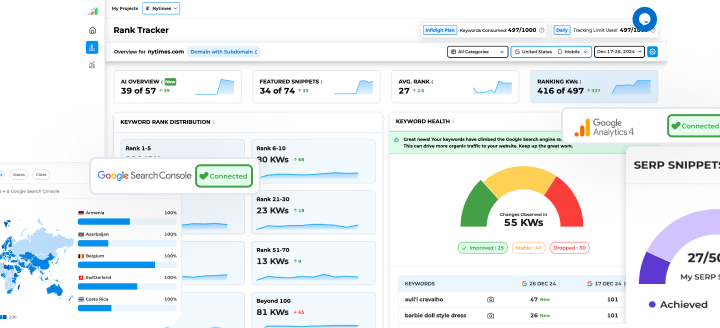
- Technical depth where our proprietary AI-SEO Infigrowth platform helps optimise crawl budgets, fix technical site issues and implement structured data.
- AI and LLM readiness, where we tailor on-page content for large language models to get you visible in AI-generated conversational search settings and summaries.
When you work with Infidigit, the proof lies in the pudding. To cite just one example, we have worked with ICICI Prudential Life Insurance to help the brand achieve 39x traffic growth from LLM platforms with our tailored strategy. At the same time, we also enabled the brand to achieve 45% growth in conversion rates through CRO. If this sounds helpful for your business, get a free SEO audit from Infidigit today to remove the obstacles preventing your business from accomplishing the organic digital growth it deserves.
Frequently Asked Questions
How long does SEO take to show results for financial services?
It usually takes about 3-6 months to show some initial improvements. Measurable ROI and compounding benefits, along with measurable lead generation, will take at least 6-12 months. It is a long-term strategy that needs patience and continuous monitoring.
Is SEO worth it for a small financial advisory firm?
Yes, SEO is hugely worth it for small financial advisory firms in India. Through the right local search query and long-tail focus, they can outrank their national peers without the huge ad budgets needed for Google Ads and other platforms.
How much does financial services SEO cost?
The costs depend on the current health of your website, your business goals, the efforts and solutions required, and the specialised skill sets that will be involved in the process. At Infidigit, we have competitive rates that always prioritise your value proposition over everything else.
What’s the difference between financial SEO and general SEO?
Financial SEO focuses on Google’s YMYL (Your Money or Your Life) and E-E-A-T (experience, expertise, authoritativeness and trustworthiness) standards. It also complies with regulatory requirements, SEBI/IRDAI guidelines, reliable sources, and financial disclaimers. General SEO only focuses on generating traffic with keywords.
Do financial services companies need local SEO?
Yes, financial services companies in various sectors require local SEO, including regional banks, branches, local insurance agents, wealth managers and so on. Local SEO helps optimise Google Business Profiles to rank in Local Map Packs and get local reviews, while capturing high-intent traffic and building regional/local trust.
How useful was this post?
0 / 5. 0