












If you work in SEO, marketing, or content, you’ve probably seen these two terms many times: branded traffic and non-branded traffic.
People talk about them in reports. Clients ask about them in meetings. Tools separate them neatly in dashboards.
But very few explain them in a way that actually makes sense.
This blog breaks it down. What these traffic types mean, how they behave, and why both matter for long-term growth.
What Is Branded Traffic?
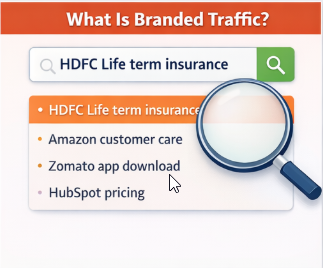
Branded traffic comes from searches that include your brand name or a close variation of it.
Simple examples
- “HDFC Life term insurance”
- “Amazon customer care”
- “Zomato app download”
- “HubSpot pricing”
In all these cases, the user already knows the brand. They are not exploring options. They are looking for you.
That’s branded traffic.
What Is Non-Branded Traffic?
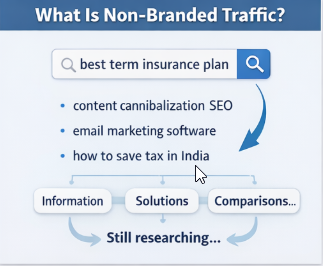
Non-branded traffic comes from searches that do not mention any brand name.
These users are still searching for:
- information
- solutions
- comparisons
- products or services
…but they haven’t decided on a brand yet.
Simple examples
- “best term insurance plan”
- “content cannibalization SEO”
- “email marketing software”
- “how to save tax in India”
This is non-branded traffic.
The Real Difference Between Branded and Non-Branded Traffic
The difference is not just the keyword.
The real difference is user mindset.
Branded traffic users
- Already trust the brand
- Are closer to conversion
- Often come for login, pricing, support, or purchase
- Convert faster
Non-branded traffic users
- Are still researching
- Comparing options
- Learning basics
- Building trust
Both are important, but they play very different roles.
Why Branded Traffic Looks “Better” in Reports
Branded traffic usually shows:
- Higher click-through rate
- Lower bounce rate
- Higher conversion rate
This makes sense.
If someone searches your brand name, they already want you.
They are not experimenting.
But this also means something important.
Branded traffic is not a strong indicator of growth by itself.
The Hidden Risk of Depending Too Much on Branded Traffic
Many websites look successful on the surface because branded traffic is strong.
But when you dig deeper:
- Non-branded traffic is flat
- New users are not growing
- Rankings depend heavily on brand recall
This becomes risky because:
- Brand interest can drop
- Ads can replace organic brand clicks
- Competitors can catch up
If your site only performs well for branded searches, growth eventually slows down.
Why Non-Branded Traffic Drives Real SEO Growth
Non-branded traffic is where SEO actually proves its value.
This traffic:
- Brings new users
- Builds awareness
- Feeds the top and middle of the funnel
- Creates future branded searches
Most strong brands today didn’t start with branded traffic.
They earned it through non-branded visibility.
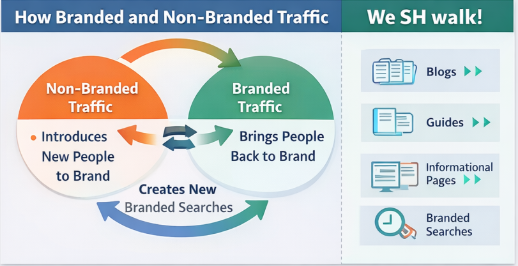
How Branded and Non-Branded Traffic Work Together
Think of it like this:
- Non-branded traffic introduces people to your brand
- Branded traffic brings them back
One feeds the other.
If you focus only on branded traffic, you’re talking to people who already know you.
If you focus only on non-branded traffic, you may get traffic but weak loyalty.
Good SEO balances both.
How to Identify Branded vs Non-Branded Traffic
You don’t need complex tools to do this properly.
Using Google Search Console
- Go to Performance → Search results
- Look at queries
- Separate:
- Queries with your brand name
- Queries without it
- Queries with your brand name
This gives you a clear picture of:
- How much traffic comes because of your brand
- How much comes because of your content and SEO
Using Google Analytics or GA4
In analytics tools:
- Branded traffic often appears as direct or organic
- Non-branded traffic is usually organic search driven
Pair this with Search Console data for clarity.
Why Clients Often Misunderstand This Difference
Many clients feel happy seeing strong branded traffic.
And that’s natural.
But branded traffic often comes from:
- Offline marketing
- Ads
- Brand campaigns
- Word of mouth
SEO’s real contribution is usually non-branded traffic.
As an SEO or content professional, it’s important to explain this clearly — in simple language, not charts alone.
How Content Plays a Role in Non-Branded Traffic
Non-branded traffic is built through:
- Blogs
- Guides
- Comparisons
- FAQs
- Educational pages
These pages:
- Answer real questions
- Solve problems
- Build trust slowly
They may not convert immediately, but they start the relationship.
This is where good content strategy matters.
Why Branded Pages Should Not Target Non-Branded Keywords
A common mistake is trying to push brand-heavy pages for non-branded keywords.
For example:
- A product page trying to rank for a “what is” keyword
- A pricing page targeting informational searches
This usually fails because:
- The intent doesn’t match
- Users bounce
- Rankings don’t stick
Non-branded keywords need helpful, neutral, educational content, not sales-heavy pages.
Measuring Success the Right Way
Don’t judge SEO success only by:
- Total traffic
- Branded growth
Instead, ask:
- Is non-branded traffic increasing?
- Are new users coming in?
- Are informational pages ranking better?
- Are branded searches growing after non-branded growth?
That’s healthy SEO.
When Branded Traffic Should Be the Focus
There are cases where branded traffic matters more:
- Reputation management
- Brand protection
- High-competition markets
- Big enterprise brands
In these cases:
- Brand SERP control
- Sitelinks
- Reviews
- Trust signals
…become important.
But even here, non-branded traffic should not be ignored.
A Simple Way to Explain This to Stakeholders
If you ever need to explain this in one line, use this:
“Branded traffic shows how well people know us.
Non-branded traffic shows how well SEO is working.”
That usually clicks.
Final Thoughts
Branded vs non-branded traffic is not about choosing one over the other.
It’s about understanding:
- Where your traffic is coming from
- What stage the user is in
- How SEO is actually contributing to growth
Strong websites don’t rely only on brand power.
They build visibility where users are still searching, learning, and deciding.
That’s where long-term SEO wins are made.